
Enterprise Resource Planning (ERP) systems form the digital nervous system of modern organizations. Selecting the right ERP solution, however, is rarely a one-size-fits-all exercise. Implementing a system designed for a global conglomerate when you are an emerging mid-market enterprise introduces crippling operational complexity. Conversely, relying on lightweight accounting tools during rapid scaling leads to fragmented data, operational bottlenecks, and missed market opportunities.
Matching your ERP platform to your company’s specific growth trajectory ensures that your technology stack acts as an accelerator rather than a friction point.
Phase 1: The Startup and Early Stage Trajectory
In the initial operational phase, business processes are dynamic, fluid, and often informal. Early-stage companies prioritize agility, rapid product iteration, and lean operating costs above rigid process standardization.
Operational Indicators of the Early Stage
- Lean team structures with multi-functional roles.
- Low transactional volumes and simplified supply chain models.
- Primary software needs focused on basic financial accounting and core CRM.
Ideal ERP Architecture
At this stage, heavy tier-one ERP implementations are counterproductive. Organizations benefit most from entry-level SaaS solutions or modular Cloud ERP entry points. These solutions offer low capital expenditure, subscription-based pricing models, and rapid deployment timelines.
Implementing lightweight systems allows growing companies to maintain financial control while remaining agile enough to adjust business models without incurring technical debt.
Phase 2: The High-Growth Scaling Phase
As revenue stabilizes and market traction accelerates, organizations hit operational complexity barriers. Processes that were previously managed via spreadsheets or basic software begin to break down under increased transactional volume.
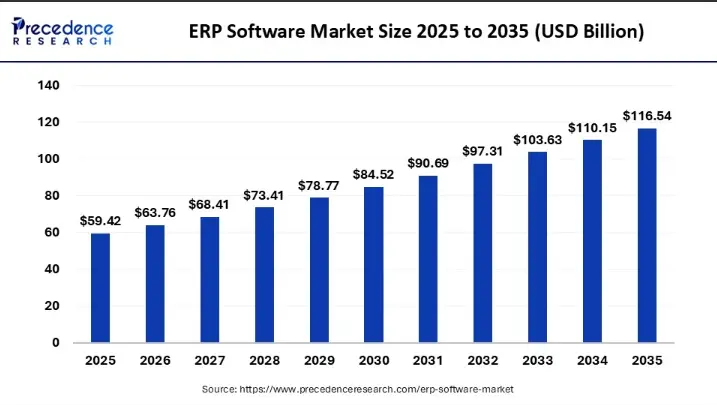
The Tipping Points for Scalable Infrastructure
- Data Fragmentation: Financial records, inventory counts, and customer management live in disconnected software silos.
- Manual Bottlenecks: Staff spend excessive hours manually reconciling reports across platforms.
- Supply Chain Inefficiencies: Inability to track inventory, purchase orders, or fulfillment status in real time.
Upgrading to Mid-Market Cloud ERP
During rapid scaling, mid-market SaaS ERP solutions provide the optimal balance between functional depth and flexibility. Platforms built on microservices architectures allow companies to activate additional functional modules—such as advanced inventory management, procurement, automated revenue recognition, and human capital management—only as needed.
Deploying a flexible mid-market platform ensures that growing operations remain streamlined while laying the operational foundation for future expansion.
Phase 3: The Established Enterprise Trajectory
Enterprise-scale organizations manage multi-entity operations, international supply chains, complex regulatory compliance standards, and multi-currency financial consolidations.
Enterprise Operational Priorities
- Single-source-of-truth data integrity across multiple international subsidiaries.
- Advanced predictive analytics and automated forecasting capabilities.
- Deep integration with enterprise security frameworks and compliance governance.
Enterprise Tier-One Architectures
For global enterprises, Tier-1 ERP suites offer deep industry-specific capabilities and extensive customization options. These robust systems handle massive transactional throughput and support complex manufacturing, distribution, and financial operations.
Whether deployed in public cloud environments, hybrid models, or private clouds, enterprise platforms deliver the reliability and control required for large-scale operations.
Strategic Evaluation Matrix: Mapping ERP to Trajectory
Selecting the right solution requires evaluating core business attributes across four primary tiers of organizational complexity.
Tier 1: Emerging Business
- Primary Objective: Cost efficiency, fast setup, core financial tracking.
- Deployment Model: Multi-tenant SaaS.
- Key Functionality: Financial accounting, invoicing, basic inventory tracking.
- Implementation Timeline: Days to weeks.
Tier 2: Scaling Mid-Market
- Primary Objective: Eliminating process bottlenecks, unifying operational data.
- Deployment Model: Cloud-native modular ERP.
- Key Functionality: Advanced inventory, automated order management, CRM integration, consolidated reporting.
- Implementation Timeline: Months.
Tier 3: Upper Mid-Market
- Primary Objective: Process optimization, multi-site management, advanced analytics.
- Deployment Model: Configurable Cloud or Hybrid ERP.
- Key Functionality: Supply chain planning, human capital management, multi-entity financial consolidation, BI integration.
- Implementation Timeline: Six to twelve months.
Tier 4: Global Enterprise
- Primary Objective: Global compliance, operational governance, continuous innovation.
- Deployment Model: Hybrid or Private Enterprise Cloud.
- Key Functionality: Global consolidation, advanced manufacturing/MRP, AI-driven demand forecasting, enterprise governance.
- Implementation Timeline: Twelve months or longer.
Key Selection Principles for Long-Term Value
To ensure your ERP investment aligns with future growth rather than just current needs, apply these core evaluation principles:
- Evaluate Total Cost of Ownership (TCO): Look beyond software licensing costs. Account for implementation services, ongoing maintenance, internal resource allocation, and future scaling tier adjustments.
- Prioritize API-First Integration Capabilities: Modern enterprise stacks rely on seamless communication between software platforms. Select platforms with open APIs to integrate specialized third-party tools as business demands evolve.
- Focus on Change Management: The primary point of failure in ERP projects is user adoption, not technology. Allocate sufficient budget and operational focus to training and change management initiatives.
Aligning your ERP platform with your operational trajectory protects capital, mitigates operational risk, and builds a foundation for sustainable, long-term expansion.